Breitbart as an Outlet for His Views on Making America Great Again
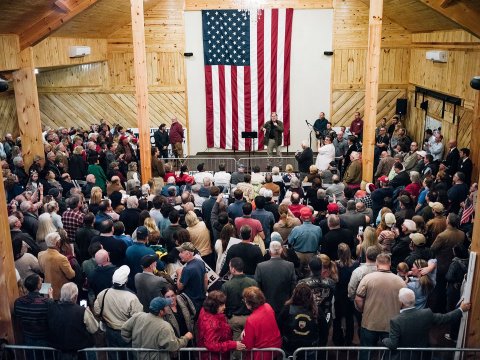
The rally in Dothan, Alabama, opened with prayer, a furious verse from Psalm 5 hurled at enemies of the Lord: "Their centre is filled with malice. Their throat is an open grave." These messengers of malice were also presumably the enemies of Roy South. Moore, the sometime primary justice of the Alabama Supreme Court then running for the U.S. Senate every bit a Republican. Foremost among those enemies was The Washington Mail service, which had published the accounts of several women accusing Moore of extremely agonizing sexual misconduct. Only they also included Senate Majority Leader Mitch McConnell, who'd equivocated in his support of Moore, and Richard C. Shelby, the senior Alabama senator who'd taken his turn every bit Judas past declaring on national tv that he would "admittedly not" vote for the fiery jurist.
Moore is a conservative Christian, and so were many of the supporters who attended that rally on December 11, 2017, just hours before polls opened across the state. The rally freely mixed religion and politics—several radiantly blond siblings came onstage to sing, and a boy definitely not old enough to bulldoze held the microphone and said, "I thank the Lord that Judge Roy Moore has shown us in the past that he will stand up for our beliefs, and he volition stand up upwards for Jesus Christ."
Stephen Chiliad. Bannon took the stage more than an 60 minutes after the rally began. Unlike many of the other speakers, Bannon did not brand a pandering allusion to the University of Alabama football programme: He seems to have as much interest in sports as a tweed-clad intellectual.
Bannon also did non talk nearly homosexuality or abortion, the 2 bug Moore and his supporters are exceedingly passionate about. Instead, he cast the looming election as a battle between those who believed in the "Trump miracle" and those who want him impeached. He then rhapsodized to the near entirely white audition nigh "the Hispanic and black working class," that would benefit from the Trump administration's stringent immigration policies.
"Economic nationalism does not care what your race is, your color, your ethnicity, your faith, your gender, your sexual preference," he said, the last of these added after a slight hesitation. Simply one affair mattered: your American citizenship. "American jobs for American workers," he said, later mentioning the black and Hispanic working class again. The notion of work as a redemptive force is central to Bannon's thinking, as well as to his own habits. As far every bit I can tell, Bannon doesn't practice much but work. Whether that fact is thrilling or terrifying depends on what yous recollect of the work he does.
20-iv hours later, I sat with Bannon in a hotel room on the outskirts of Montgomery. Nosotros had both spent the evening at the RSA Activeness Center downtown, where the Moore entrada had its headquarters. It was a campaign coasting on conviction. When I'd run into Moore adviser Dean Young before in the evening, he was sure that victory was assured. So were the hundreds gathered in the downtown Montgomery ballroom. The blond siblings sang again. The speakers who'd praised Moore as a human being of God the nighttime before did it all over once more. So the returns started to come up in. Older people prayed. Stunned younger people stared at iPhones.
Moore refused to concede that night, only he'd lost, and Bannon knew it. As did his many enemies. "Suck it, Bannon," tweeted a celebrating Meghan McCain, daughter of Senator John McCain, Republican of Arizona, and herself a prominent conservative figure.
Bannon is reviled by many on the left, only he has just as many enemies on the right. Establishment Republicans fear his renegade populist campaign will ensure that Democrats score significant victories in the 2018 midterm elections. "He's a cancer," Charles J. Sykes, the popular, Wisconsin-based talk radio host who recently left the Republican Party, told me.
RELATED: Bannon says he's 'totally uncowed' by Roy Moore loss
Such calumny might wilt some, only not Bannon, who described his comportment after the Moore loss as "totally uncowed." He'd left the White House in Baronial and in October promised a "flavor of state of war" confronting what he saw as the moribund Republican Party; McConnell, whom he accuses of disloyalty to Trump; and House Speaker Paul D. Ryan, whom he one time called a "limp-dick motherfucker."
Bannon may not be beloved, just those he's trying to slay are likewise reviled in many quarters. Congress now enjoys an approval rating of xiv.7 percent, according to Existent Articulate Politics. In August, McConnell's approval ratings with his Kentucky constituents were 18 per centum. The more Bannon is maligned by powerful just disliked Republicans, the easier it is for him to paint himself as the truth-telling insurgent out to save the GOP.
"Steve Bannon should send Mitch McConnell a fruit basket," jokes Andrew Surabian, who worked with Bannon in the White Firm and now serves as his aide-de-camp. He may similarly detect himself the recipient of an Edible Organisation from Thomas Due east. Perez, the Democratic National Committee chair for helping, in the eyes of many, a Democrat win in this claret-carmine state. The Autonomous National Commission has been vowing to implement a "50-land strategy" e'er since the cataclysmic 2016 election. Have the Democrats found their perfect weapon in Steve Bannon?
In Praise of the Unreasonable
Kickoff to speak at the luncheon for black conservatives at the Willard InterContinental Hotel in Washington, D.C., was Senator Ron Johnson, Republican of Wisconsin. Deploying his Midwestern monotone to lethal effect, Johnson talked at length about Southward corporations and pass-through entities. When information technology came time for questions, a woman who chosen herself a "red-blooded black American" pleaded with Johnson to help the African-American community. He listened respectfully, mentioned some social program he was fond of, then talked about pass-through entities again.
Ii hundred and l people had not come to this gorgeous neoclassical ballroom to hear homilies near tax brackets. Nor had they come for the Caesar salad wraps. They had come to hear Steve Bannon.
When Bannon was introduced by Raynard Jackson, founder of Black Americans for a Meliorate Future, the super PAC that organized the event, phones went away; backs straightened. Jackson quoted George Bernard Shaw: "The reasonable man adapts himself to the world: The unreasonable one persists in trying to conform the earth to himself." Then Bannon the Unreasonable took the stage.
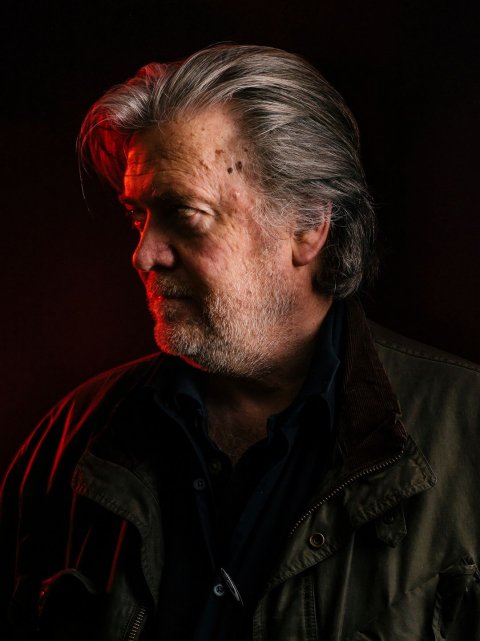
Subsequently the applause quieted, he began to speak in his customary mode: allusive, complimentary-flowing content delivered in the precise, confident cadency of a military officeholder (seven years in the Navy). Instead of standing at the podium, he paced the stage, dressed in a black sports jacket and blackness shirt. In a rare nod to sartorial decorum, his shirt was tucked into a pair of khakis. He looked similar an agitated history professor crossed with a revival-tent preacher. Bannon is a practicing Catholic, but his true religion is what he calls economic nationalism. It is the principle he believes won Trump the White House and could ensure Republican domination for the side by side 75 years. "He's proven that economic nationalism works," Bannon says of the president.
RELATED: Republicans think Steve Bannon is a huge loser
Despite that surety, Bannon tin can be somewhat vague regarding what, exactly, economic nationalism entails. The clearest explanation I got came from Surabian, who says Bannon'due south economic nationalism has three pillars: regulatory relief for business organisation owners, tax cuts for middle-class families and an infrastructure program for the poor. The first ii are long-standing Republican dogma, while the tertiary borrows from the Works Progress Administration of Franklin D. Roosevelt. But all iii require, in Bannon's conception, a much less generous approach to both legal and illegal immigration. This thrills some and appalls others.
Bannon's outreach to African-Americans seems calculated, at to the lowest degree in part, to blunt criticisms that he is either a white nationalist or a white supremacist. While he has been chosen those things, besides equally a racist, misogynist and anti-Semite, this is by no means a complete listing of his alleged transgressions. It doesn't help Bannon's rep that Breitbart News often publishes articles that, while conventionally conservative in content, are topped with incendiary headlines referencing "lesbian bridezillas" or, in the case of neoconservative Bill Kristol, a "renegade Jew." Several of Bannon's one-time colleagues accept attested to his decency in apparent publications. These do not appear to have had the intended outcome.
Deploying a line he would repeat days afterwards in Dothan, Bannon explained to those blackness conservatives gathered at the Willard that "a central thesis" of his economic nationalism was "programs that stop the destruction of the black and Hispanic working class." He cited the billions of dollars the United States devoted to military campaigns in Afghanistan and Iraq, asking the audition to imagine if similarly generous amounts had been lavished on Baltimore, St. Louis and Detroit. "Have we lost a sense of our priorities?" he asked.
A woman in the audience answered loudly, somberly, as at church when some collective sin has been named: "Yes!"
Later on, a member of the audience asked Bannon nigh the lack of minorities in senior West Wing positions. "It'due south inexcusable," he answered. "Just inexcusable. You can't defend it."
I saw Jackson a couple of nights later, at a party for Trump campaign alumni. He is clearly glad to take Bannon every bit an ally. At the same fourth dimension, much of his work involves convincing people that Bannon is nothing like the image of him readily available in news reports, late-dark talk show monologues and social media memes. This is a chore often complicated by the words and deeds of Bannon.
"In the media's mind, information technology's inconceivable that a blackness person would hold with anything that Steve Bannon had to say," Jackson told me later on. He says that while friends and business associates are initially skeptical, hearing Bannon talk invariably dispels their concerns. They are particularly intrigued past his statement that uncoupling the United States from its foreign obligations would give African-American entrepreneurs access to capital letter they take historically been denied. "I believe," Jackson says, "that Steve has the ability to pull together a coalition to blow people's minds."
Stephen of Arabia
In 1916, the British intelligence officer T.Eastward. Lawrence arrived on the Arabian peninsula to organize the region's Arab natives in a revolt against the ruling Turks of the Ottoman Empire, who'd been there since the 16th century. Lawrence quickly gained renown for his grasp of what would make the Arab Revolt successful.
1 year later, Lawrence published "Twenty-Seven Manufactures," in which he offered counsel to his countrymen. "Bury yourself in Arab circles, have no interests and no ideas except the work in manus, so that your brain is saturated with 1 affair only."
When I visited Bannon in early Dec, a biography of Lawrence was one of ii books in his hotel suite. "The construction of this is actually very much similar the Arab Revolt," Bannon told me of the political motility he has been trying to build since he left the White House four months ago. The more than applied aspects of that revolt have included his vow to run master candidates against every Republican in the U.South. Senate except for Ted Cruz of Texas, and fielding Business firm candidates. A war of that scale could toll well over $100 million, perhaps testing the patience (and wallets) of conservative donors who want to see balloter victories, not intellectual ones.
Bannon expressed an admiration for how Lawrence united disparate Arab factions without forcing them to cede their identity. He believes he can play a similar office for the right wing of the Republican Party, bringing together ideological tribes in a furious fight against establishment forces led by McConnell and Ryan.
For now, he is pulling together an informal alliance of conservatives who share his populist agenda. "What we're doing is reaching out to all these grassroots groups," Bannon told me in Montgomery, "whether it's the religious right, whether it's the Tea Political party groups, whether it's the Dave Bossie groups." (Bossie is head of the conservative activist organization Citizens United and was deputy entrada manager for Trump during the 2016 presidential race.)
He concedes that Moore wasn't an ideal candidate. In fact, Bannon initially supported Representative Mo Brooks, Republican of Huntsville, who was knocked out of the chief by McConnell-aligned super PACs that spent $10 meg on the race. McConnell'due south candidate (and, briefly, Trump's) was Senator Luther Strange, whom Moore defeated in a primary runoff.
"Approximate Moore has never been, really, an economics guy," Bannon said. Put more frankly, it is virtually impossible to imagine Moore and Bannon in conversation. And given that Bannon's chat includes frequent and dismayingly casual references to yuan-pegged petroleum pricing and the Nullification Crisis of 1832, he may observe it difficult to field candidates who are able to connect with him and, at the same time, with suburban voters in Northern Virginia.
Related: Steve Bannon is not running for president, associates say
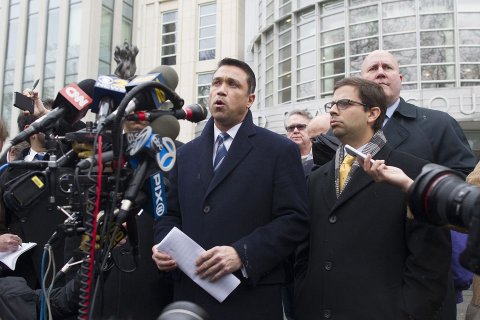
Bannon promises a stronger race from Arizona'due south Kelli Ward, who is running for the U.South. Senate. "Immigration and merchandise will exist at the forefront of the Arizona race," he says. Bannon is also supporting Michael 1000. Grimm, a Republican from New York City seeking to regain his seat in the U.S. House. Grimm, who spent seven months in prison for tax evasion, is seeking to replace Daniel M. Donovan Jr., besides a Republican. In May, Donovan was i of 20 Republicans to vote against the repeal of the Affordable Care Act. In Oct, Bannon endorsed his challenger, with Grimm tweeting a photograph of the two men posing at the "Breitbart Embassy," the Capitol Hill townhouse that serves as the Breitbart newsroom. Bannon also lives there.
Grimm says Bannon reminds him of his father'due south family, German language and Irish immigrants who worked factory jobs in Brooklyn and saw little purpose in niceties, political or otherwise. "If President Trump is not successful, we're gonna lose our state as nosotros know it," Grimm says. "Nobody understands that better than Steve Bannon." Apparently, Ryan does not share that view. Several days afterwards Bannon endorsed Grimm, Ryan endorsed Donovan. That puts Bannon, once again, in the position of battling his ain party instead of the Democrats.
What Bannon sees as principled battle, many Republicans fear is a suicide bombing. Equally the Republican strategist Tim Miller explains, Bannon's influence could pb establishment conservatives to tack right, as Ed Gillespie did, in hopes of attracting Bannon's support. (Gillespie lost in November's race for governor in Virginia.) Conversely, Republicans unwilling to do so, only also fearing attacks from Breitbart News for moderate positions, may choose not to run.
That's likely why, The New York Times reports, some Republicans " intend to kneecap" Bannon "before he has the chance to recover" from the Moore loss. Rick Wilson, the veteran Republican strategist, says the GOP needs to "beat his candidates down the moment he endorses them."
Merely Bannon, who calls himself a street fighter, may welcome such attacks, as they could sharpen the contrast between him and a moneyed but unpopular Republican establishment. That volition, in turn, make him seem even more the tribune of the mutual man.
Bannon Agonistes
The second book in Bannon's hotel room was a bound printout of a congressional study on Communist china. "I'm going back and getting every government certificate I can put my easily on on China," he said, brandishing the thick volume. "That's my light reading."
If Richard Nixon "opened" Prc with his visit there in 1972, Bannon is intent on endmost it. To him, Cathay's rise is frightening simply its dominance of global affairs is not yet inevitable. He believes China'southward ascension to superpower condition has been abetted by what he calls "the Bush-league/Clinton crowd," which welcomed the nation into the World Trade Organization (Clinton) and failed to recognize it every bit a growing geopolitical menace (Bush).
That Cathay poses a mortal threat to American hegemony is an unshakeable commodity of faith for Bannon. He told me he "admittedly" endorses the hawkish views of Peter Navarro, the Death by China author whose engagement past Trump as a White House adviser signaled that a trade war was coming. Bannon thinks the war is already here, and that Americans are as slow to recognize incipient doom as the Poles were in the summer of 1939, when the Wehrmacht gathered on Poland's western border.
"Information technology's one-sided. They accept all the forces of state power driving this," he says. He was alluding to China's most ambitious plans: a $1 trillion international infrastructure program known as I Belt One Route; the introduction of the biggest and fastest mobile telecommunications network in the world; and "Made in Red china 2025," an upgrade to 10 industries, including biomedicine, it and make clean-energy generation.
Simply while Bannon yearns for a confrontation with China, others worry near potentially devastating effects on the American economy, citing research that a trade war could lead to millions of lost jobs and higher prices for consumers.
Trump was a protectionist long earlier he met Bannon. In the 1980s, he was a frequent critic of Nihon, which was then in the midst of an economic expansion. "They come over here, they sell their cars, their VCRs," Trump complained to talk show host Oprah Winfrey in 1988. "They knock the hell out of our companies." In 2015, he launched his presidential campaign with a like broadside against Japan, though this time without mention of VCRs. He described a national landscape resembling The Grapes of Wrath: "They tin't go jobs, because there are no jobs, considering China has our jobs and United mexican states has our jobs."
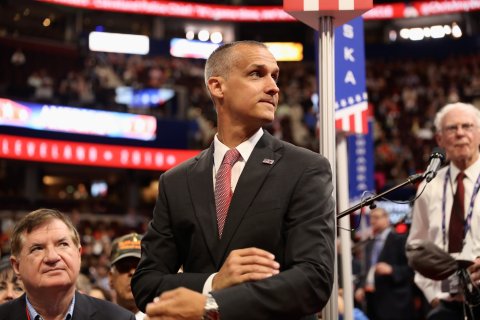
Trump's campaign manager in the early on days, when his bid for the Republican nomination seemed either a joke or a publicity bid, was Corey R. Lewandowski, who channeled Trump's pugnacity and bluster. Next came Paul J. Manafort, who piloted the campaign to Cleveland for the Republican National Convention. Merely by late summer, Lewandowski says, his "primary juggernaut" had been perverted past Manafort into a "full general election failure." In his refreshingly punchy new volume about the entrada, Let Trump Be Trump, co-authored by Bossie, Lewandowski has a newly hired Bannon watching, aghast, as Manafort gives a television interview from the Hamptons, dressed in canoeing attire. Manafort was gone within days.
The man who replaced him was fiddling known to the kinds of people who make it their business to know everyone in Washington. He'd worked for Goldman Sachs, made some conservative documentaries in Hollywood and collected millions from having purchased a share of the Seinfeld idiot box serial dorsum catalog. Now he was running Breitbart News, a potent force on the right still obscure to readers of The New York Times. A profile in Bloomberg Businessweek showed Bannon in shorts and untucked dress shirt, looking like a mildly disgruntled burrow potato.
Bannon'south elevation to entrada manager seemed to signal desperation, a reaction he recalls now with delight. "As soon as I took over, they said, 'Oh my God, Trump's going to lose by 25 points now, they brought in the mad bomber, just to destroy his enemies on the way downward.'" He does non harp on the victory over Clinton quite as much every bit Trump does, but he has mentioned it in every speech I've heard him requite: in California, Alabama, Washington. For him, it is a lesson that the moribund establishment can be defeated. And must be defeated.
Entrada alumni oftentimes follow their victorious candidate to the White House, merely not since Karl Rove arrived at the West Fly with George W. Bush-league has an appointment been met with so much alarm—Bannon'due south new position would be main political strategist, a printing release several days later the ballot said. "Bannon volition exist the most powerful person in Trump's White Business firm," wrote Ryan Lizza of The New Yorker.
And so why didn't Bannon use that power to abet more than forcefully for his populist views? Miller, who ran communications for the Jeb Bush campaign and is now one of Trump's nigh vociferous Republican critics, believes those ideas were never more than than an ideological Potemkin village for "cultural and racial grievance." He says Bannon's genius was in spotting the get-go shoots of that grievance in the wild ecosystem of right-wing cyberspace news outlets.
Although Bannon reportedly sought a peak tax rate "with a 4 in front of information technology," the notion of a tax increase was dismissed as whimsy, "a expressionless cat bounce," in the words of free-market place activist Grover Norquist. Infrastructure Calendar week, which the White Business firm could have used to make the case for a Works Progress Assistants–style plan, concluded with a proposal to privatize air-traffic control. Nor did Bannon push for the kinds of smaller-scale solutions that both Republicans and Democrats could take supported: faster internet in rural communities, free community college, constructive job-retraining programs, expansion of opioid-handling programs. These would not have been revolutionary, but they would take likely been constructive.
Bannon left the White House in mid-August, after clashing with national security adviser H.R. McMaster, principal economic adviser Gary D. Cohn and the president's influential daughter, Ivanka Trump. (Again, by no means a complete list.) At the time, he looked miserable, exhausted.
"I'yard so happy since I've been out of the White Firm," he says now. "I'm merely non congenital to exist a staffer, right? In the White House, I had a lot of influence, simply at the end of the twenty-four hours, you're a staffer. It's only a different affair. It's very hierarchical, you've got your lanes you gotta stay in. Information technology's not the manner I curlicue."
Bannon continues to regularly talk with the president. But while he said that he spoke to Trump for more than thirty minutes on the mean solar day of the Alabama special election, someone with admission to the White House telephone call logs said the telephone call was but ix minutes long.
That discrepancy may exist telling. A senior White House official, who could speak simply on the status that her name non be used, told me that the relationship between Trump and Bannon has "soured," fifty-fifty as media reports continue to paint Bannon as a Rasputin effigy singularly capable of influencing the president. She dismissed any notion that Bannon would be advising the president on strategy for the 2018 elections. "We accept no desire to engage with him in any way in 'xviii on campaigns or other topics," the official told Newsweek.
The White House official adds that Bannon's influence on Cathay policy has been exaggerated: "People want to credit Steve for some of the language and the rhetoric, but these are things the president has been talking nearly for years."
As far every bit Bannon is concerned, no corporeality of palace intrigue tin eclipse Trump'due south work on the economy. Asked if Trump were an economical nationalist, he says, "Look at his policies." He attributes Trump's success to the protectionism that animates them both, listing the executive orders that, he believes, are going to be accelerants to the American economic system, the manufacturing sector in particular: "the 301 on intellectual property, the 201 on aluminum, the 232 on steel."
While he admits that the tax bill congressional Republicans just passed is flawed, he won't denounce information technology as a giveaway to corporations and billionaires, having apparently adopted the widespread confidence of congressional Republicans that getting anything passed—no matter how unpopular—is better than passing cypher.
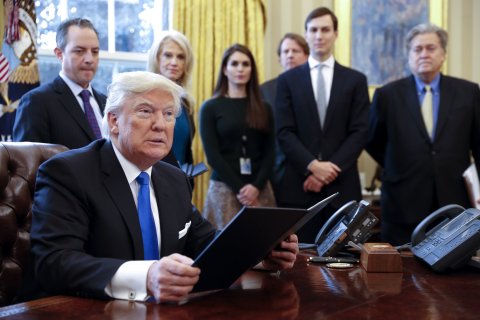
"President Trump should be eligible for the Nobel Prize in economics," Bannon says. "He's proven that economic nationalism works. He's getting the animal spirits flowing in America."
The Right-Wing Liberal
Robert Kuttner was vacationing in Tanglewood, the bucolic classical music retreat in Lenox, Massachusetts, when he got an email from Bannon's assistant, inviting him to meet at the White Business firm, where Bannon was then employed. Unable to travel to Washington, Kuttner agreed to a phone call. "Bannon promptly called," Kuttner wrote in an account of their exchange.
"I've followed your writing for years," Bannon told him. This stunned Kuttner, who edits The American Prospect, a progressive magazine consistently critical of Trump and the Republican Party. Nevertheless, Bannon recognized that Kuttner, like other progressives, shared his antipathy to free trade and militarism. Their many differences, especially on social bug, he appeared to ignore.
"We're at economic state of war with China," Bannon told Kuttner, in an interview that was astonishing for its incautious honesty. He promised to install Cathay hawks at the State Department while admitting that there was "no armed forces solution" to the collision with an increasingly bellicose Democratic people's republic of korea. Asked nearly the white nationalists who were purportedly his allies, and whom Trump had praised equally "very fine people," Bannon dismissed them as "a drove of clowns."
Bannon was gone from the White House inside two days. Even if he was already on his mode out, the Kuttner interview was a middle finger thrust high into the air. It was also an intriguing reminder that in that location's some overlap betwixt the far left and the far right, at to the lowest degree on economic views. The political extremes bend toward each other in their antipathy to the free-market commercialism of the flattened, digitized world. Twelve percent of people who voted for Vermont'south Senator Bernie Sanders, a self-described democratic socialist, voted for Trump in the full general election.
I spoke to a Democratic congressional staffer on Capitol Hill who was invited to the Breitbart Embassy considering Bannon had learned of his work and was intrigued by the possibility of cooperation. The staffer, who asked that his proper name non be used, said he was "shocked" by Bannon's "involvement and level of respect." They talked about populism and state of war. "His willingness to engage was hit. Information technology was a surreal experience."
"It's obvious he could not last in the Trump administration, in role due to his opposition to wars of choice, hypermilitarism and endless U.S. occupations, and also some domestic policies where he sides more with liberal Democrats than with Republicans, including full employment, wage growth, fair trade, antitrust enforcement and serious spending on infrastructure," says the Democratic staffer, who fears existence "crucified" by fellow liberals on the Hill for merely meeting with Bannon.
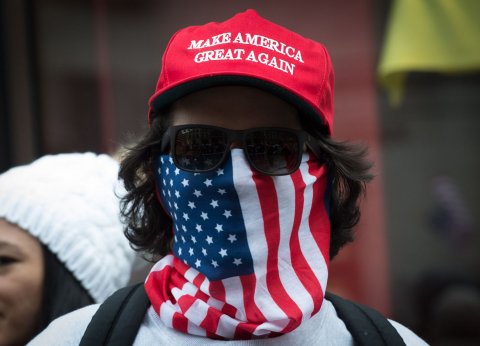
Bannon's agreement that class discontent would eclipse party amalgamation in the 2016 election was prescient, and even his harshest critics concede that. Steve Schmidt, a top adviser on John McCain'due south 2008 presidential campaign, credits Bannon with seeing the shift to populism before many others did. Merely he calls Bannon's economical nationalism motion "an absurdity" that will ruin the Republican Party unless McConnell and Ryan shell him downward earlier the 2018 midterms. "The revolution he speaks of is a freak show," Schmidt says of Bannon's movement. "The but thing missing is someone in a Chewbacca costume next to him on a stage."
Kuttner, too, is skeptical that Bannon can win converts from the left. "Hitler had a terrific interstate highway organization," he says. "Hitler likewise had a terrific welfare state. But that doesn't hateful progressives have annihilation in common with Hitler." He says this non to compare Bannon to Hitler just to caution that "incidental overlap" shouldn't be exaggerated into a bigger political confluence. Kuttner notes, like many others I spoke to, that Bannon has thus far failed to field a candidate who embraces his eclectic ready of ideas. "Unless he's planning to run for part himself, he's mostly blowing smoke," Kuttner says.
Bannon is planning no such run. And yet he continues to flirt with ideas that could be more attractive to the center-left than the far right. He believes, for example, that Silicon Valley has become too powerful. "Google and Facebook ought to exist public utilities. I remember they're too large for command. And I call back that data ought to exist held in trust. These ought to be regulated like utilities. Like the gas works."
It's an intriguing idea, one that has been wafting through liberal outlets for some time. Of course, nothing volition make that idea toxic to liberals quite like an endorsement by Bannon. Democrats tin can only hope he doesn't start preaching well-nigh a $15 an hour minimum wage.
The Fighter Still Remains
Political campaigns are similar military ones, and non only for the lack of sleep. The losing faction resorts to blame and recrimination, while the winners embalm their victory in flawless amber. The House of Representatives could flip in 2018 and, under Democratic control, vote to impeach Trump. But those who fought for him in the months leading upwardly to November viii, 2016, those happy few, will always take Wisconsin.
One cold nighttime in December, Bannon threw a party for Lewandowski and Bossie, who'd but published Let Trump Be Trump, their brisk account of Trump's march to Washington. The political party was held at a steakhouse beyond from the Play a joke on News headquarters in midtown Manhattan. The identify slowly filled with bourgeois luminaries, similar Ann Coulter, who brushed off someone who wanted to snap her picture, and Sean Hannity, wearing a green field coat that made him look like a suburban dad. Loud and happy, Lewandowski bounded between guests. Cindy Adams, the gossip columnist, wore a white coat. An olive-oil importer told me about the proto-Trumpian culture warrior Patrick Buchanan and his collection of antique guns. I retrieve salary, ample and succulent.
Bannon came near the end of the affair. When he did, the already crowded room imploded around him, equally if a new gravitational field had formed. He was the star among stars. Bannon knew this, accentuating his import by dressing downwards for the occasion, wearing a barn coat and cargo pants, which both looked comfy and entirely inappropriate in this room of tailored suits. Truthful power is dressing exactly as you damn well please.
Bannon is unique among those who take left the Trump administration in that he has non attempted to merchandise on his association with the president for personal profit. Enough of others accept, even if their association was a lot more tenuous. Having vowed to continue fighting for Trump when he left the White House, Bannon has done just that. Losing a skirmish in Alabama is unlikely to temper his zeal. Bigger battles loom. "One of the things he does, that nigh of united states in Washington don't do, is he thinks in terms of history," says Keith Koffler, the White House Dossier author who recently published a biography of Bannon, Bannon: E'er the Rebel . "It volition be very little of a deterrent to him at all, what happened in Alabama."
Several days subsequently Moore's loss, pundits and columnists were however arguing whether Bannon was to arraign, what the election meant for Democrats, what information technology meant for Republicans, what information technology meant for Americans and whether information technology would relieve republic.
Bannon, meanwhile, went to Tokyo. In that location, he gave an address to a bourgeois group, praising Japanese Prime number Government minister Shinzo Abe for being "Trump before Trump" by reviving Japan's long-dormant nationalist impulses. "Nihon has every opportunity to seize its destiny," he said. Merely but if it stands with the United States against Communist china.
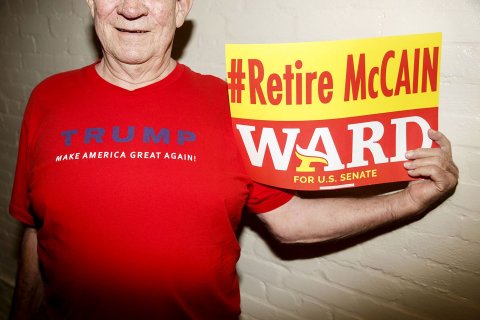
Back habitation, Trump released a national security strategy that branded China a growing threat. "Cathay expanded its power at the expense of the sovereignty of others," the document says. "Its nuclear arsenal is growing and diversifying. Part of Communist china'due south military modernization and economic expansion is due to its admission to the U.S. innovation economy, including America'due south world-form universities." If this wasn't written by Bannon, it was inflected with his ideas.
But almost every bit if to underscore how much Bannon's influence has diminished, the White House presently thereafter appointed Susan A. Thornton its top Eastern asia diplomat. This was seen as some other defeat for Bannon, who'd bragged to Kuttner that he'd have her expelled from the State Department.
And then now it is winter, and Bannon is in the wilderness, tromping through the snowfall, preparing for bags battles to come. He hears the crackling reports of incoming fire merely doesn't bother to duck. "I retrieve it'south one of my superpowers that I don't intendance what people say. I really don't." For him, this is only the showtime of his movement, not the terminate: the starting time inning, not the 9th, as he put it to me in Montgomery, with stars falling over Alabama, Roy Moore demanding a recount, and reporters pecking abroad at their laptops, writing obituaries for Bannon and his revolution.
"We're fighting on tonight," Bannon said as aides came into his hotel room with gravid, greasy numberless of Arby'southward. "We'll get up and fight tomorrow morning."
An earlier edition of this article incorrectly deemed Keith Koffler'due south biography of Bannon "authorized." It is not an authorized biography.
Source: https://www.newsweek.com/2018/01/05/steve-bannon-plan-make-america-great-again-without-trump-760683.html
0 Response to "Breitbart as an Outlet for His Views on Making America Great Again"
Post a Comment